
Organised Hope
How to turn bold ideas into daily practice in 2026

After running hope-based workshops and consulting for six years, it is time for a small refresh of our service offering.
So today’s Substack is a small public service announcement sharing the hope-based services and trainings available in 2026. Scroll to the end for the usual hopey, changey stuff roundup.
Why we need to organise hope
In the last six years, I have seen how hope-based workshops can open people up to new ways of doing things. But implementing new ideas is hard. That is why we have developed our methodology to make sure we can help organisations and movements implement hope-based change.
View the full service menu and pricing here:

Fear is organised. Social change is reactive.
Is your work driven by other people? Constant feeling of reacting to crisis? Does this stop you testing new tactics and implementing new strategies?
We often struggle to translate new tactics and strategy into lasting change. PDF strategies and messaging guides don’t change culture and daily practice.
Hope-based communication was first developed to solve this problem: it was as a checklist to prompt my Amnesty International colleagues to make small shifts in their day-to-day work; to ask themselves new questions and form new habits of hope.
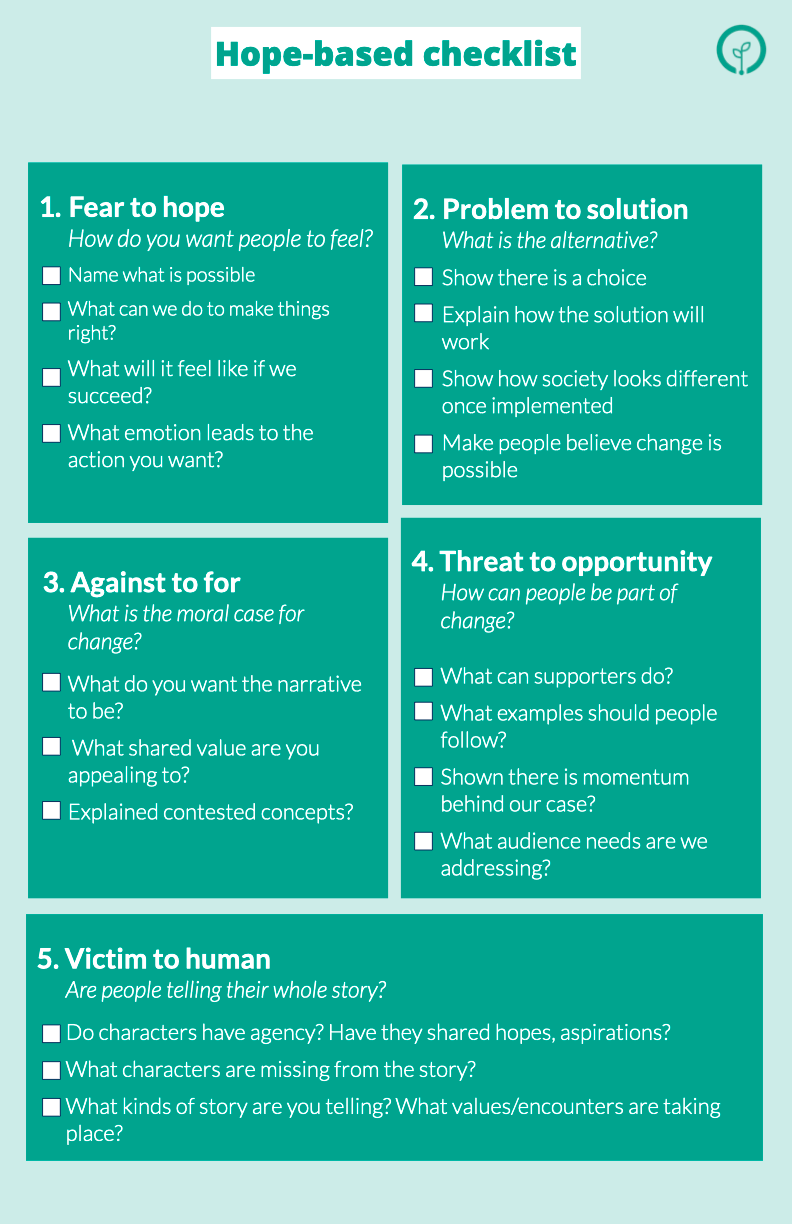
Being hope-based gets you out of reactive mode
What if change started within? To change the world, we need to change how we think. We need to train new habits.
To modernise our activism for this new era, people need to drive change in their daily work.
Change grows from new habits that we can train. We help activists design new messages, tactics and strategies they can apply to their daily work, with ongoing support to grow that hope into action. Because we are more likely to apply what we design and create ourselves.
To be hope-based means to base our work on the change we want to see happen. We set our own agenda, driven by long-term goals: attitude, behaviour and culture change.
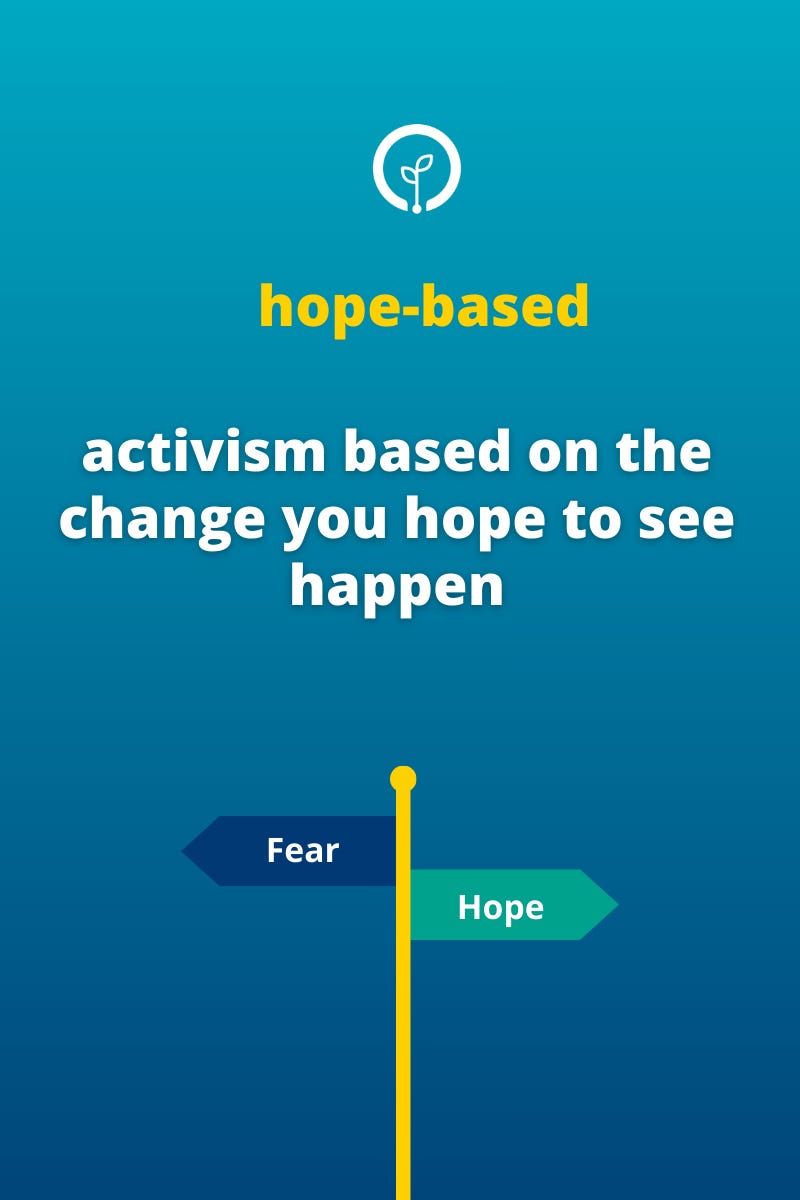
The hope we need right now is in us.
A New Hope
Our new, updated hope-based methodology focuses on helping people implement radical new ideas in their day-to-day work, with ongoing support before and after the “aha moment” of the workshop.
Here is how we aim to grow hope deep into the roots of your activism:
Training the hope muscle: exercises that change how we feel, think, act and speak.
Workshop follow-up: we’ve found the most valuable sessions are the strategy retainer sessions where we help clients follow through on new ideas, overcoming challenges and setbacks and showing how new narratives apply to daily work.
Practical daily tools: we create tools that will sit on your desk, not in your drawer. Hope-based was born as a checklist. We also want to create new rituals and habits that will integrate your hope into your everyday action.
Organised Hope: what hope-based experts can do for you
Here are the core services you can get from hope-based experts around the world. Contact me for more information or feel free to connect with one of them directly.
Offer 1. Hope-based communication - narrative reframing
This pathway focuses on the simplest form of change: encouraging key people to start integrating aspects of hope into their daily work, making subtle, initial changes, encouraging key people to integrate hope-based theory into their daily work and decision-making. This is where we begin nudging to bring about small, yet crucial mindset changes.
This offer goes back to our origins, doubling-down on the simplest, most effective way to kickstart adoption of new approaches.
Above all, this is for people who want to learn about narrative and framing: because anyone in social change should feel able to work on narrative.
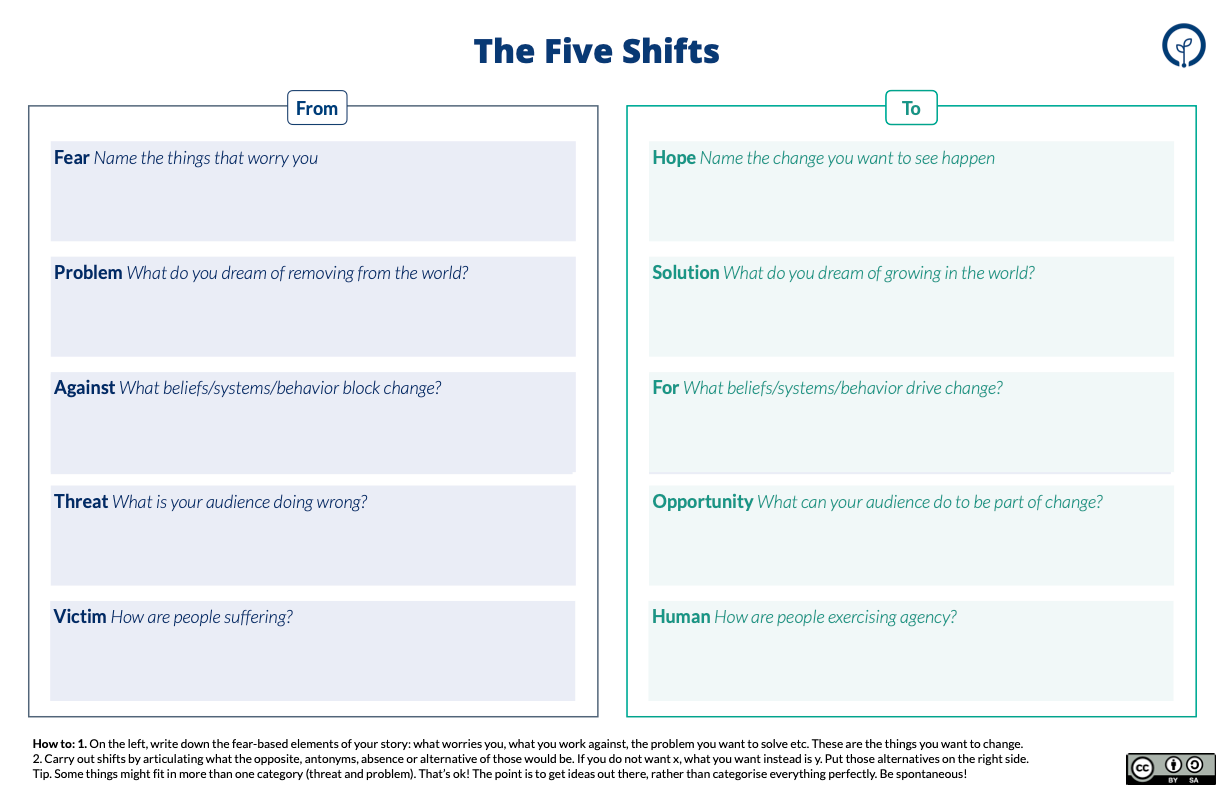
Offer 2. Hope-based strategy - create your own narrative change strategy
We co-create a hope-based narrative and a strategy to bring it to life, and support its roll out, whether working with agencies or directly with movements and partners.
We have a simple but effective template for this: message+audience=story. Articulate your values message, identify your target audience, then ask yourself what it looks like for your audience to act on your values. Once you know this, you can organise your movement to “be the narrative”. We have used this formula to create narrative change strategies around migration, civil society and corporate accountability.
This is for organisations that want to rollout a specific campaign to change a narrative, whether working with an agency or smaller groups who lack the resources and need to run a “low-tech” campaign.
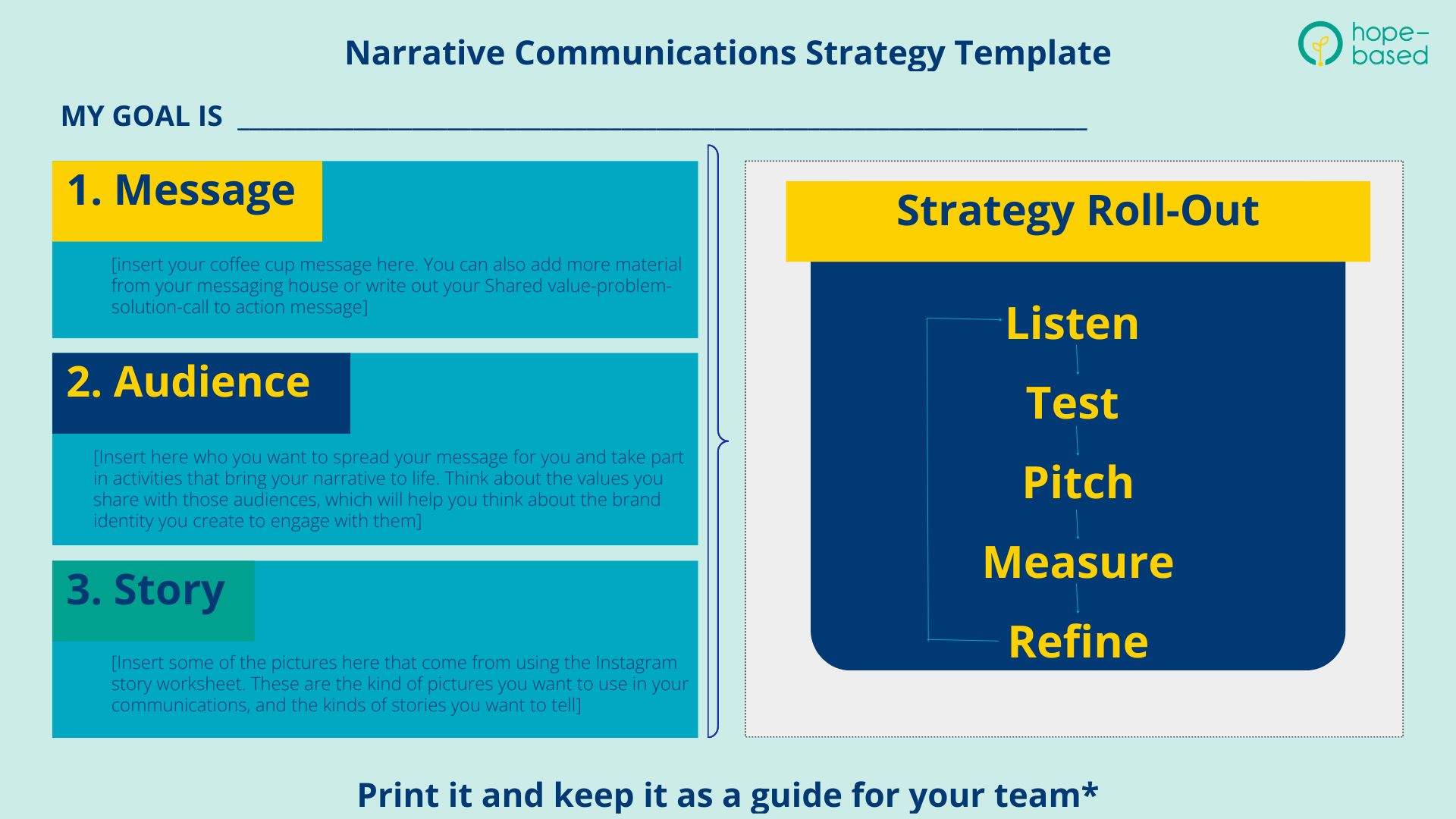
(I know from personal experience how hard it is to carve out time to create a new strategy and get organisational buy-in for it. That’s why I’m also planning a one-off small group strategy co-design course for individuals in the Spring. Get in touch if you are interested.)
Offer 3. Hope-based mindset - learn how to hope
This brand new programme adapts tools from psychology and sport science to help activists nurture resilience and creativity in the face of growing threats.
I have long believed that we cannot wait for leaders to improve movement culture. Organisations also have internal narratives: the stories we tell ourselves that drive how we behave towards our colleagues, and how we treat ourselves. We have to articulate the culture we want and shape it ourselves, through our own words and actions.
This course evolves from the Rewire Your Mind programme we ran with Unhack Democracy, where we found that hope can be a source of both resilience and creativity.
This is for all the people who said: "I want to learn how to hope.”
Book your hope-based workshop+ today:
Delivery options: how we grow hope into action
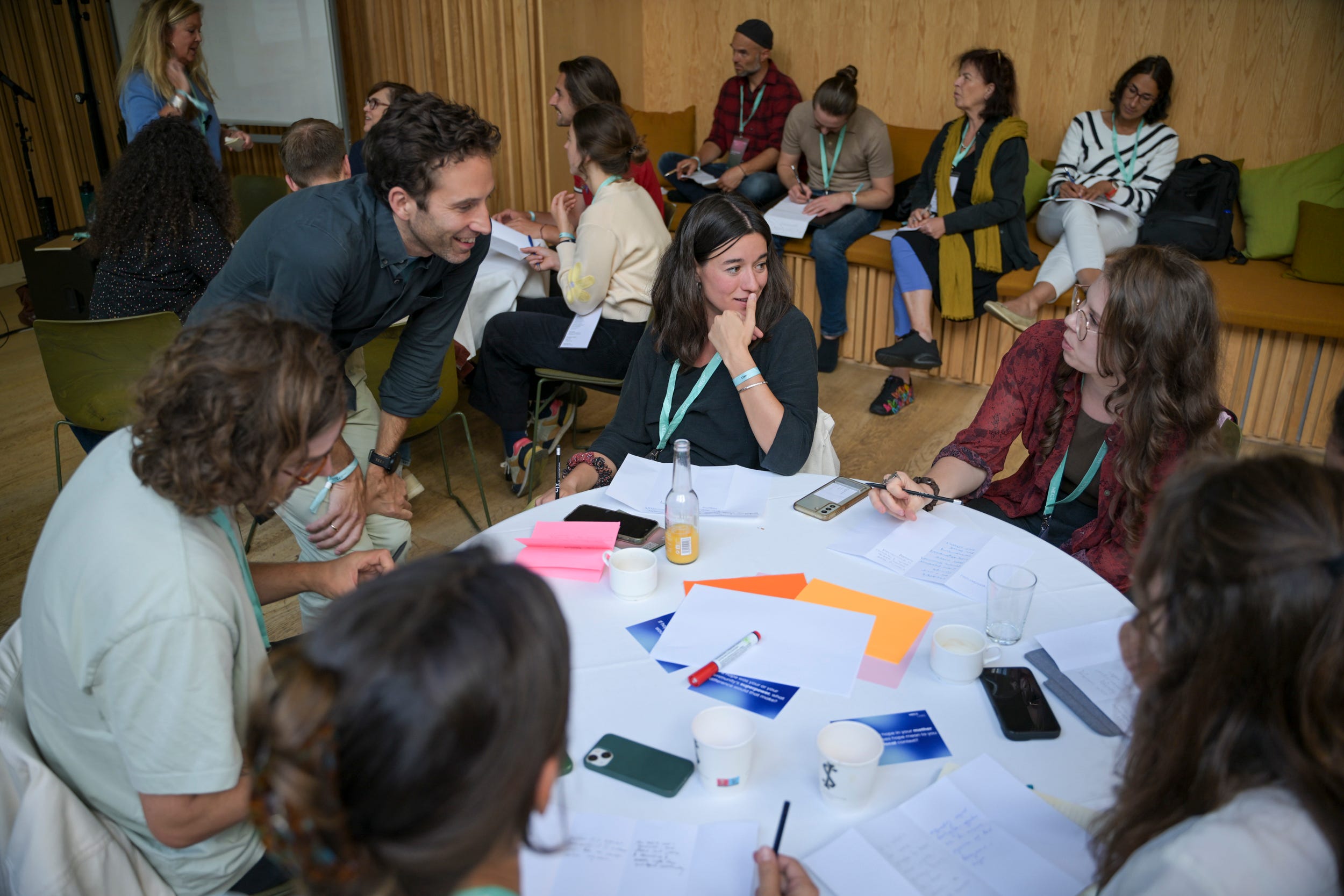
Format 1. Workshop+
Your standard in-person workshop, plus…. we go into it prepared to go deep, and we leave with a follow-up structure (via our strategy retainer) already in place to ensure ideas turn into practice.
Format 2. Webinar+
Hope-based was born in the midst of the pandemic, which showed us that distant teams and movements can build strong bonds online. I have found that with careful preparation, we can get almost as much done through online co-creation sessions, especially when we have regular ongoing check-ins and strategy implementation support.
Format 3. Video & Retainer (budget)
We know budgets are tight right now. So this year we have a new offer for low-budget or grassroots orgs: watch our core training videos in your own time. We will focus the time spent with your consultant on questions and adapting the hope-based approach to your issues.
Format 4. Toolkit (senza workshop)
Another lesson from my years of consulting: people who can have the most narrative change impact often have the least time to think about it, let alone take part in a reframing workshop. So while I think the spirit of hope-based is for people to create their own narrative, in this offer we try to minimise the time investment needed.
We will use audit, surveys and interviews to find your values and vision and prepare a pack for you. It will contain a new narrative based on your values, along with practical tools for you to implement it in your daily work. For example, our Visionary Leadership package for leaders is built on a stump speech, message house and campaign playbook.
DIY Hope
For people who want to participate as individuals, I’m also planning to run some open courses for individual sign-up this year, starting with a strategy co-design this spring, followed by the new Mindset course in summer. Stay tuned for more on this.
If you want to know more about these offers or a proposal for your organisation, get in touch!
Hopey-changey stuff
“To resist is not only to oppose; it is also to care, to rebuild, to imagine.” MEP Lina Gálvez Muñoz on resisting fascist capitalism (my Dad sent me this one - gives me hope to see some people becoming (even) more progressive as they age!)
OluTimehin Kukoyi’s fictional essay about a future world with little-to-no births.
Substack tip: Our friends at Rewire on hope vs the far-right.
Substack tip: ““The audacity of hope” wasn’t branding…His roots in that tradition gave him access to frameworks for sustaining hope that purely secular politics keeps trying and failing to replicate.” Liz Bucar on religion and the left.
What’s making us hopeful
Great ad from Parents for Future UK: funny and solutions-focused
Brain science corner - why you should make harder asks of your supporters
Apathy often looks like indifference, yet it is usually something more subtle: people avoiding the task of deciding whether it is worth acting.
When we try to persuade those who feel disengaged that the situation is urgent enough to deserve their involvement, we trigger an internal cost-benefit calculation that stalls them. We think we are simply stating facts, yet we are often constructing a silent question in people’s minds about whether it is worth it. Whatever point you make, consider the other side of the coin. Write your point, then write the counterpoint, so you can see the calculation your audience might be making.
“The key to changing everyday behaviour is to make the evaluation of costs (effort) and benefits (rewards) a habit that doesn’t seem too much like hard work.”
Instead, we can show how easy it is to act. Rather than chiding or trying to convince, offer a small task and help people recognise that they are already taking steps in that direction. Our fear of complacency, combined with a lack of a clear set of actions we want people to take, often leaves audiences suspended. Show them the plan. Reduce the choices. Instead of “Car or bike” or “Plane or train,” help people step into a simple identity: I am someone who takes the green option.
Quote of the week
“These times are what hope activism was made for…” - Thanks to Monica Roa for keeping me hopeful!